Back to Library
White Paper · 6 June 2026
View on SPIRITSeed Intelligence: The SeedKeepers Collection App & Data Sovereignty
Every seed collection generates information — about Country, climate, provenance and culture. Seed Intelligence is the practice of stewarding that knowledge, governed by Traditional Owners and supported by the SeedKeepers Collection App.
Across Australia, enormous effort is being invested in restoring landscapes, recovering biodiversity and preparing ecosystems for a changing climate. Governments, Traditional Owners, conservation organisations, mining companies and community groups are all contributing to a growing restoration economy.
At the centre of almost every restoration project sits a simple but essential resource: seed.
For decades, the focus of the native seed sector has been on finding, collecting, processing and storing seed so that it can be used for conservation, rehabilitation and revegetation. This work remains critical. Without seed there can be no restoration.
Yet as restoration programs grow in scale and complexity, it is becoming increasingly clear that seed is only part of the story.
Every seed collection generates information. We record where a species was found, when it was collected, how much material was gathered and who collected it. We observe rainfall patterns, flowering events, population health and landscape condition. We document provenance, genetics, storage requirements and restoration opportunities. Traditional Owners contribute knowledge about species, seasonal indicators, cultural significance and environmental change.
Taken together, this information becomes far more valuable than a collection record. It becomes intelligence.
The challenge is that much of this knowledge is scattered across notebooks, spreadsheets, reports, databases and individual memory. Information is often collected for one purpose and never used again. Valuable observations remain disconnected from restoration planning. Cultural knowledge may be documented in one place while ecological data sits somewhere else entirely.
As restoration activity expands across Australia, this fragmentation becomes increasingly problematic. The future of restoration will depend not only on our ability to collect seed, but on our ability to understand the information that travels with it.
SeedKeepers refers to this as Seed Intelligence.
Seed Intelligence recognises that every seed carries a story. It carries information about Country, climate, species distribution, ecological relationships and cultural connection. It contains clues about where restoration should occur, how landscapes are changing and what future ecosystems may require.
A seed collection is therefore not simply a transaction. It is the capture of knowledge from a particular place at a particular moment in time. The purpose of Seed Intelligence is to ensure that this knowledge is not lost.
— The SeedKeepers Collection App —
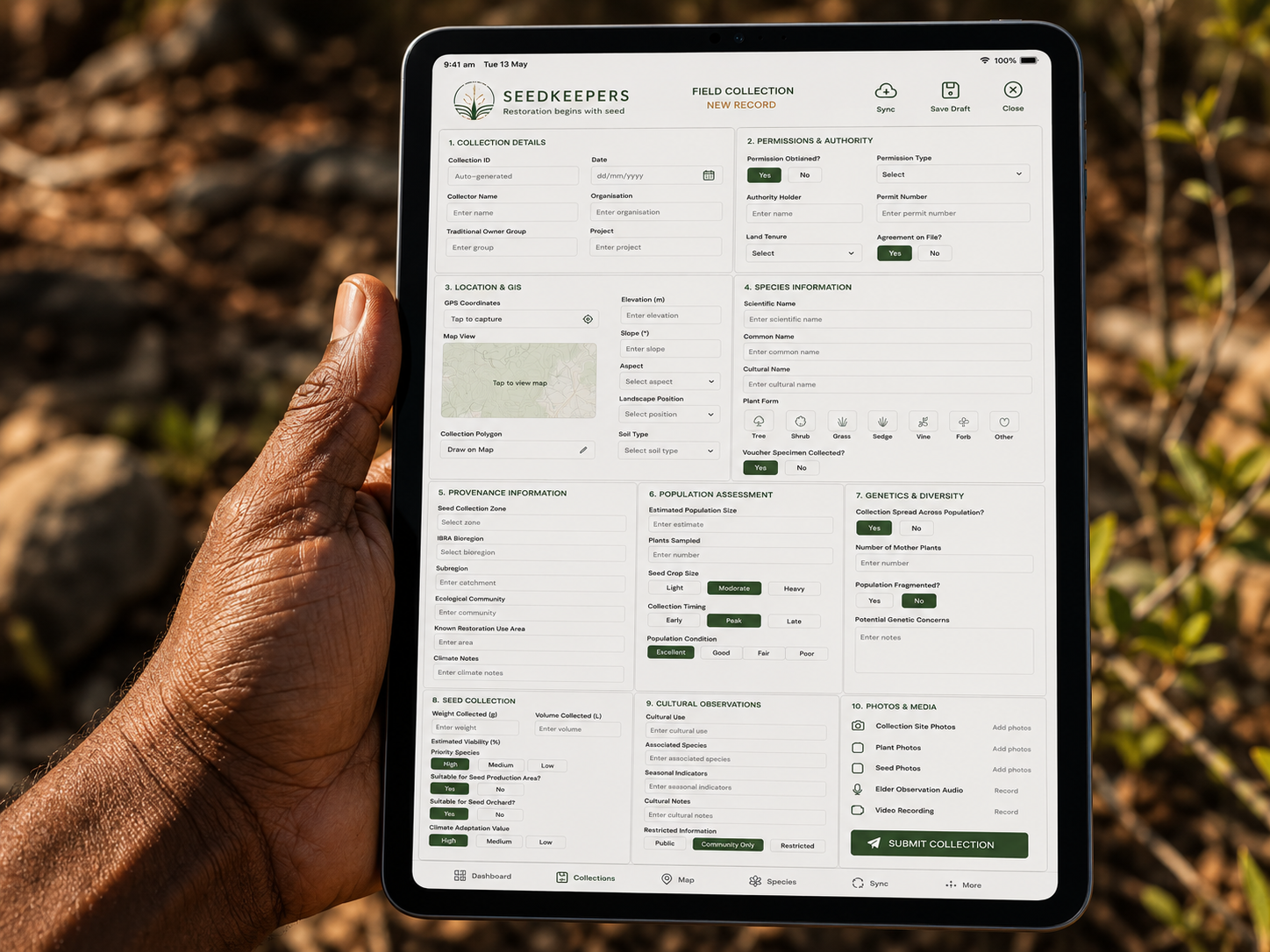
Modern collection systems allow information to be recorded directly in the field through mobile devices and mapping applications. Collection records can include provenance information, photographs, ecological observations, restoration priorities and spatial data. Audio recordings can capture Elder observations and cultural knowledge. Mapping tools can link collections to restoration sites, Seed Production Areas and long-term monitoring programs.
The SeedKeepers Collection App is designed for the field. Permissions and authority are recorded alongside species, location and provenance. Cultural observations sit beside ecological notes. Photos, audio and video can be linked to the same record. Restoration intelligence — priority species, suitability for Seed Production Areas, climate adaptation value — is captured at the moment of collection, not assembled afterwards from memory.
However, technology is only part of the solution. The more important question is who controls the information.
— Data Sovereignty —
For Indigenous communities, data sovereignty is not a technical issue. It is a governance issue.
Across Australia, Traditional Owners continue to contribute knowledge, observations and expertise that strengthen restoration outcomes. Yet information generated on Country is often stored in systems that are owned, managed or controlled by external organisations.
SeedKeepers supports a different approach. Information generated on Country should remain connected to Country. Traditional Owners should determine what information is collected, who can access it, what can be shared publicly and what should remain restricted. Cultural knowledge should be governed through community protocols, not simply database permissions.
This is why Indigenous Data Sovereignty sits at the centre of the Seed Intelligence model.
The role of technology is not to extract information. The role of technology is to support stewardship.
Secure, password-protected systems allow communities to manage information according to their own priorities and governance arrangements. Different levels of access can be applied to different types of information. Some records may support restoration planning and public reporting. Others may remain visible only to Traditional Owners or authorised project partners.
Not all knowledge is intended for public access. Not all information should be treated the same. Good governance recognises this.
— Stronger Restoration Outcomes —
Seed Intelligence also creates opportunities to strengthen restoration outcomes. When collection records, provenance information, mapping data and restoration planning are connected, communities and practitioners can make better decisions. They can identify gaps in seed supply, track the movement of seed through restoration projects, understand climate adaptation opportunities and build more resilient restoration systems.
Most importantly, they can maintain the connection between seed and Country.
This connection is often lost as seed moves through supply chains, restoration programs and commercial transactions. Yet the long-term success of restoration depends on understanding where seed came from, what knowledge is associated with it and how it should be used.
SeedKeepers believes the future of restoration lies in reconnecting these relationships.
The challenge facing Australia is not simply producing more seed. The challenge is building systems that allow knowledge, provenance, cultural authority and stewardship to move alongside the seed itself.
Because every seed carries more than biological material. It carries knowledge.
And knowledge, like seed, requires careful stewardship.
seed intelligencedata sovereigntycollection appindigenous datatechnologystewardship
Filed by SeedKeepers