Restoration is not simply about getting plants back into the ground.
It is about rebuilding resilient plant populations.
Every seed carries genetic information shaped by thousands of years of adaptation to local conditions. The decisions made today about seed sourcing and plant genetics will determine the health and resilience of Australia's future ecosystems.
That is a genetics conversation. And it is one of the most important conversations the restoration sector is not yet having at scale.
What we are interested in
SeedKeepers is interested in seed quantity.
And in the five things almost no one is measuring.
Provenance
Seed sourced and matched to Country — its origins, climate window and cultural significance.
Genetic Diversity
Collections that capture the breadth of a population, not the convenience of a single tree.
Adaptation
Choices that anticipate the climate populations will live in — not only the one they grew in.
Future Resilience
Populations capable of reproducing, recruiting and persisting over decades.
Long-term Ecosystem Function
Restoration that re-establishes the relationships — soil, pollinators, fire — not just the plants.
Restoration that holds — long after the funding cycle ends.
The Cascade
Most restoration conversations stop at the first two levels.
The future of restoration sits in the last three.
Seed Quantity
Where most conversations begin.
Species Diversity
And where they typically stop.
Genetic Diversity
The first level the sector often skips.
Adaptive Capacity
Populations that can respond to a changing climate.
Resilient Landscapes
Restoration that holds, generation after generation.
Our Lane
SeedKeepers is not a genetics research organisation.
We help connect Traditional Owner knowledge, seed systems, provenance considerations and emerging genetic science to support better restoration outcomes.
That positions SeedKeepers as a bridge between communities, restoration practitioners, nurseries, researchers, forestry and mining rehabilitation.
Community
Restoration practitioners
Nurseries
Researchers
Forestry
Mining rehabilitation
SPIRITTM
Seed Provenance Intelligence & Restoration Information Technology
The future of restoration depends on understanding more than seed.
SPIRIT is an integrated provenance intelligence platform developed by SeedKeepers — bringing ecological, genetic, cultural and climate datasets together so practitioners can make better decisions about native seed and restoration.
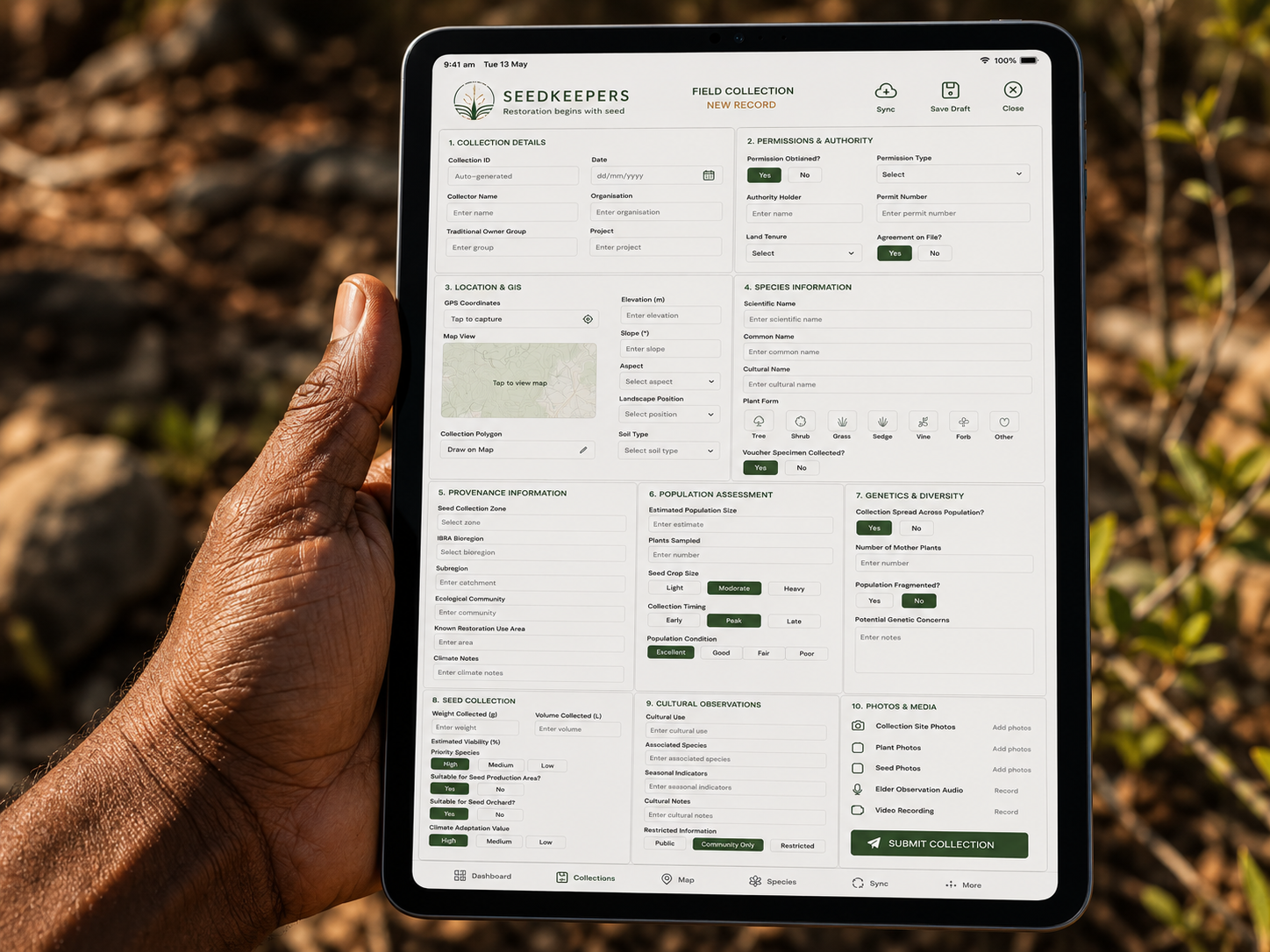
SPIRITTM on iPad · in the field · seedkeepers.app
Registered Partner Access
Currently available to approved SeedKeepers partners, Traditional Owner organisations, ranger groups, research institutions and restoration practitioners participating in pilot programs.
Access SPIRITAvailable to registered SeedKeepers partners and pilot participants.
The Question